To be honest, when I first tried setting up my own Minecraft server, I had no idea that a server crash—or a “server-bombing” attack—could happen so suddenly.
At first, I just wanted to play on a survival server with a few friends, so I casually spun one up on my local computer. The experience was great for the first few days; we mined and built houses together, and the vibe was excellent. But before long, problems arose: the server started lagging frequently, and sometimes it was impossible to connect at all.
I initially thought it was a configuration issue. I tweaked the Java memory parameters, switched server cores, and even reinstalled the environment several times, but nothing improved. After checking the logs, I realized this wasn’t a standard performance issue—it was a classic DDoS traffic attack.
That was the moment I realized that once a server’s IP is exposed to the public internet, it becomes an easy target for scanning and malicious attacks.
My First Server Crash: Unable to Even Log In
The worst incident happened one weekend when I’d prepared the server specifically to host a building competition with friends.
Trouble started almost immediately after the server went live. Players kept disconnecting, the console was flooded with abnormal connection requests, and latency spiked to absurd levels, leaving the server in a state of near-total paralysis. No matter how many times I restarted it, the fix was only temporary before it crashed again.
It was incredibly frustrating—all I wanted was to play the game, yet the server was completely out of control. I even suspected my hardware couldn’t handle the load, but I later confirmed that sustained traffic attacks were exhausting all available resources.
Finding a Solution: Exploring Professional Server Hosting
After that experience, I started asking myself a serious question: Should I really be trying to run a server on my local machine?
I began researching VPS options and various game server hosting solutions. VPS hosting was certainly cheap, but it required me to manage firewalls and security policies myself, and it lacked game-specific optimizations. As for local hosting—well, that was out of the question due to instability and high risk.

That was when I first discovered Shockbyte, a service specializing in game server hosting. What attracted me was actually quite simple: it explicitly offers free DDoS protection optimized specifically for game servers. This was crucial for me at the time, as I had no desire to go through another “sudden server crash” scenario.
The Shockbyte Experience: Protection Enabled by Default
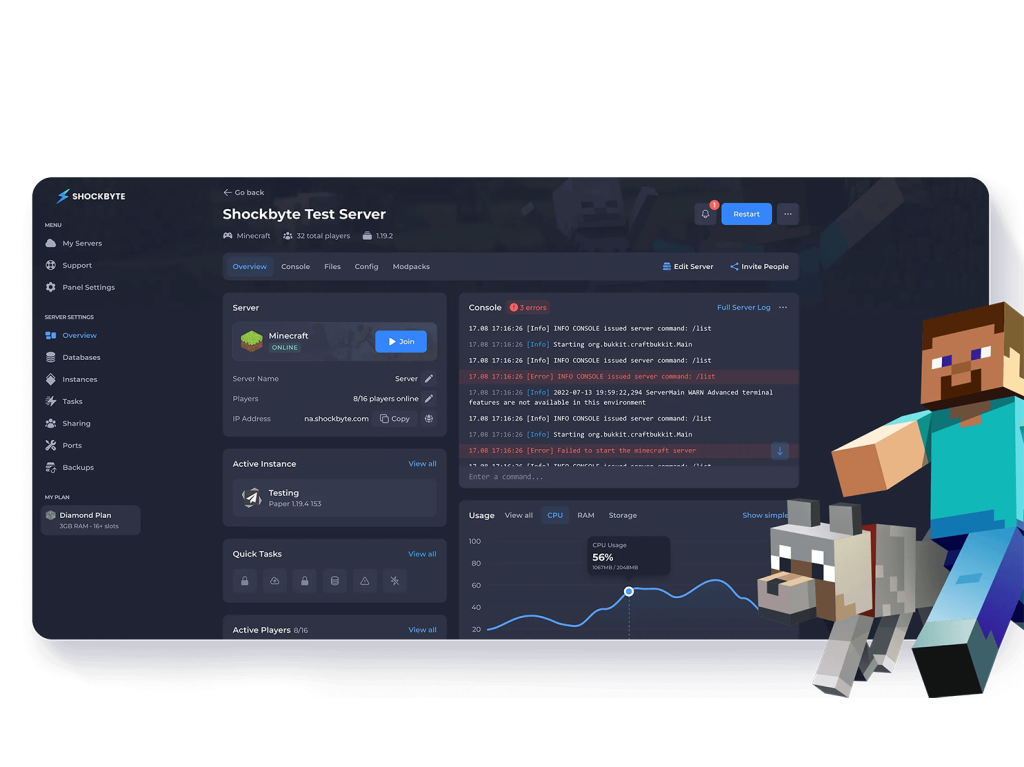
Migrating to Shockbyte was far easier than I expected. Creating the server, selecting a plan, and launching the instance were all handled through a visual interface—no complex configuration required.
What surprised me most was that DDoS protection was enabled by default, requiring no extra setup. For someone like me—not a professional sysadmin—this meant I didn’t have to study complex security rules or worry about missing a critical configuration step.
Once the server was live, I simply shared the IP with my friends, and they could join the game immediately; the whole process was incredibly smooth.
A Real-World Stress Test: Another Attack, But No Crash
Some time after the migration, a friend messaged me: “It looks like someone is messing with the server again, but… everything is fine?”
I was a bit nervous at first and immediately checked the logs. Sure enough, there were abnormal traffic spikes and a massive influx of connection requests. Yet, interestingly, the server didn’t freeze or drop the connection, and the in-game experience remained virtually unaffected.
That was the moment I truly understood the meaning of “protection”: it’s not about making attacks disappear entirely, but ensuring they don’t disrupt the experience for legitimate players.
In my previous setup, a situation like this would have meant an immediate server crash, but here, the system automatically filtered it all out.
Reflections After Using It for a While
After using Shockbyte for some time, my perspective on the service became more grounded in reality.
The most noticeable change was the vastly improved server stability; disconnections dropped significantly, and latency remained steady even during peak times. More importantly, I no longer needed to constantly restart the server or worry about it getting hit by an attack at any moment.
Running a server used to be a source of significant stress, as you never knew if it might crash the very next second. Now, that anxiety has largely vanished; the server feels like a reliable, stable service rather than a project requiring constant firefighting.
My Honest Advice If You’re Planning to Host a Server
If you’re just looking to host a server for friends, the most important factors aren’t raw performance specs, but stability and security. In my experience, hosting a server locally or using a standard VPS often leads to issues—especially when public internet access is involved, which significantly increases the risk. Opting for a dedicated game server solution like Shockbyte, which comes with built-in DDoS protection, saves a lot of headaches down the line.
In other words, if you want to avoid the kind of scenario I faced early on—where the server would suddenly crash, forcing me to spend the whole night fixing it—choosing a managed service with built-in protection offers much greater peace of mind.
What truly puts me at ease isn’t the hardware specs, but the assurance that the server won’t get taken down by an attack
I used to constantly worry about the server freezing, getting attacked, or dropping the connection. Now, those concerns are largely gone because the built-in protection handles most of the risks for me. Ultimately, the biggest shift wasn’t just an improvement in server performance; it was a change in my own mindset.
For me, the real value of Shockbyte isn’t just about speed; it’s that I can actually focus on the game itself, rather than constantly monitoring the console and trying to rescue the server.