To be honest, when I first got into multiplayer game servers, my understanding of “hosting a server” was very simple.
I thought that as long as I could spin up a free server and let friends join in, that was enough.
That’s why I started out using Aternos.
However, as the server evolved from a “temporary session” into a “long-term small community,” problems began to surface. It was during this process that I discovered Shockbyte and truly experienced the gap between “free solutions” and “paid hosting.”
Starting for Free: The Real Experience with Aternos
When I first started using Aternos, it felt like it was “good enough.”
Signing up was simple; a single click on the start button would generate a server. For beginners, there was virtually no barrier to entry.
That’s how our first server began: three to five friends, a survival world, and a few basic plugins here and there. We’d hop online to mine and build houses—it was a very relaxed experience.
But over time, that “relaxed” nature began to feel like a limitation.
The most obvious issue was the wait time. Every time we wanted to play, we had to start the server first—sometimes waiting minutes or longer—which disrupted the flow of the game.
Then there was the unstable performance. Whenever the player count rose slightly, the server would struggle; exploring the map caused lag, complex Redstone contraptions slowed things down, and we even experienced occasional disconnects.
More importantly, it wasn’t a “persistent world,” but rather a temporary environment that required manual startup. This meant you couldn’t really run it as a long-term, permanent server.
The Turning Point: When the Server Became a “Long-Term Hub”
What really made me realize things were getting more complex wasn’t a single, dramatic crash, but the gradual shift of the server from a “temporary place to play” to a “spot where people logged on every day.”
At first, we just fired up a survival world for a bit on weekends. Later, we formed a regular group, and people started suggesting long-term activities—like parkour challenge maps, rotating PvP matches, and even a simple mini-game lobby to switch between modes.

The problems didn’t appear all at once; they emerged gradually. Take parkour maps, for instance: they’re fine for solo practice, but the rhythm shifts completely when multiple players challenge them simultaneously. If someone’s game lags slightly while loading new chunks, the jumping cadence breaks, disrupting the flow of the entire course.
PvP scenarios faced similar issues. What started as casual matches between friends eventually turned into serious competition, making latency a critical factor. Sometimes, I’d execute a move, but the feedback would lag by a split second, creating a disjointed, frustrating experience.
Survival worlds were actually the most stable, yet even there, the moment someone started constructing massive builds or complex automated systems, the server’s overall fluidity would suffer—though players often didn’t notice or mind at first.
The moment that really struck me wasn’t a total crash, but a casual remark made after an event ended: “It doesn’t feel as smooth to play now as it used to.”
It was that experience of things “gradually becoming sluggish” that made me realize the server was no longer just a temporary room, but a space in constant, ongoing use.
Trying Shockbyte: Moving from “It Works” to “I Want It to Stay Stable”
That’s when I started seriously looking for a solution better suited for long-term operation, which led me to Shockbyte.
What initially drew me in wasn’t the performance specs, but its straightforward positioning: it was built specifically for game server hosting, rather than being a generic VPS or a temporary tool.
My main concern wasn’t “can it be faster?” but “can we avoid sudden instability?” For us, the biggest issue wasn’t just lag, but the unpredictable fluctuations.
For example, the game might suddenly stutter when the player count rose, then inexplicably return to normal; that uncertainty actually impacted the experience more than the latency itself.
The migration process was uneventful—we simply moved the old environment over and reconfigured it. What really made me notice the difference wasn’t a single “aha!” moment, but the realization over the following days that there was simply “nothing that needed fixing.”
Before, the first thing I’d do upon logging in was check the status, test the connection, and ask others if they were experiencing lag. After the migration, those steps faded away; I could just log in and start playing immediately.
It was a subtle change, but crucial for long-term operation, as it meant the server no longer required constant “babysitting”—it could simply exist and run reliably on its own
Changes After Switching: From “Fluctuating” to “Stable”
The most immediate change lies in the speed and stability of accessing the server.
Previously, with Aternos, one often had to wait for the server to boot up; with Shockbyte, the server runs continuously, allowing for instant access without any waiting.
The improvement in smoothness is even more noticeable.
The experience on parkour maps shifted from “choppy” to “seamless and fluid.” Players used to fail jumps frequently due to lag spikes, but such incidents have dropped significantly; failures are now mostly due to player skill rather than latency.
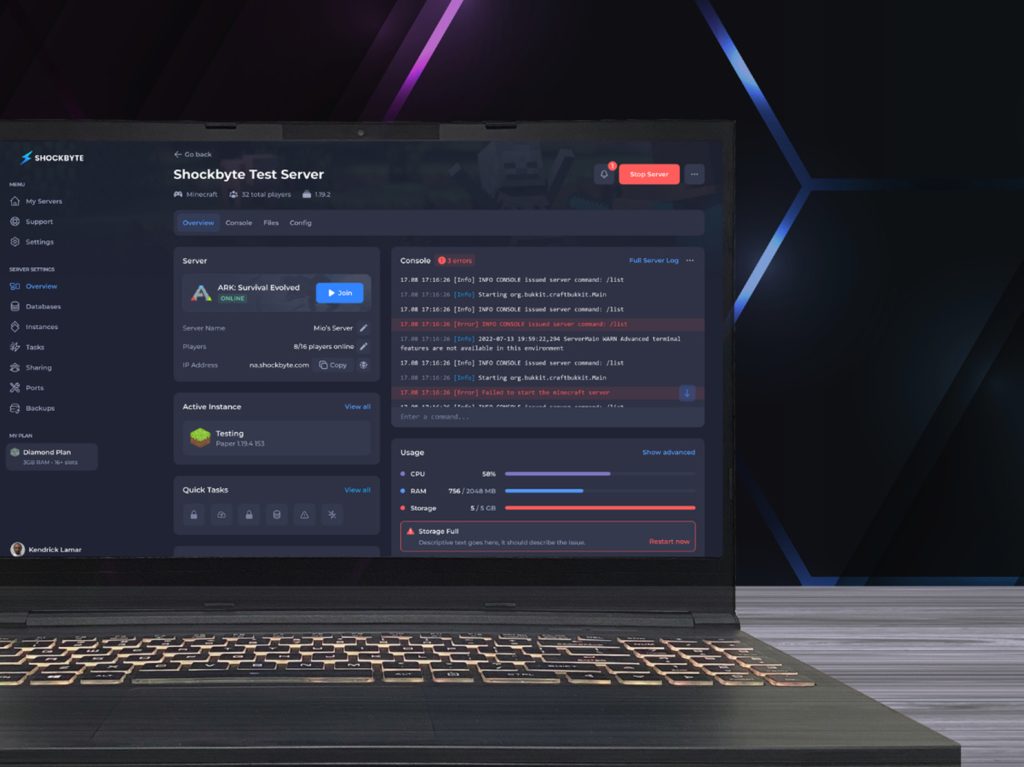
The PvP experience has also improved drastically. In the past, hit registration was often inconsistent due to lag, but now combat feedback is immediate, meaning outcomes depend on skill rather than network fluctuations.
The survival world has also transformed from something that could slow down the entire server at any moment into a stable, reliable foundation; complex builds and automated contraptions no longer compromise the overall experience.
Long-Term Operation: Temporary Room vs. Persistent World
This distinction becomes increasingly clear over time.
Aternos is akin to a “temporary room.” You turn it on when needed and off when not; it is suitable for casual multiplayer sessions and light gameplay, but not for long-term operation.
Shockbyte, on the other hand, is like a “persistent world.” It stays online, allowing you to jump in anytime without waiting or worrying about its status.
This difference has a profound impact on player behavior.
With Aternos, our routine was “wait for the server, then start playing”;
With Shockbyte, it became “log on anytime—the world is always there.”
Choosing a Server Means Choosing the Future of Your Gameplay
The difference between Aternos and Shockbyte isn’t just about free versus paid services; it is the difference between a “temporary experience” and “long-term operation.”
One is suited for getting started, while the other is suited for the long haul.
If you only play occasionally with friends, Aternos is perfectly adequate. However, if you aim to build a truly stable small-scale community—hosting parkour, PvP, survival, and mini-games over the long term—then stability is the key factor.
For me, the most significant aspect of this transition wasn’t the performance boost, but the fact that the server evolved from something that “required constant management” into a world that simply exists naturally. And that is the true essence of long-term operation.